
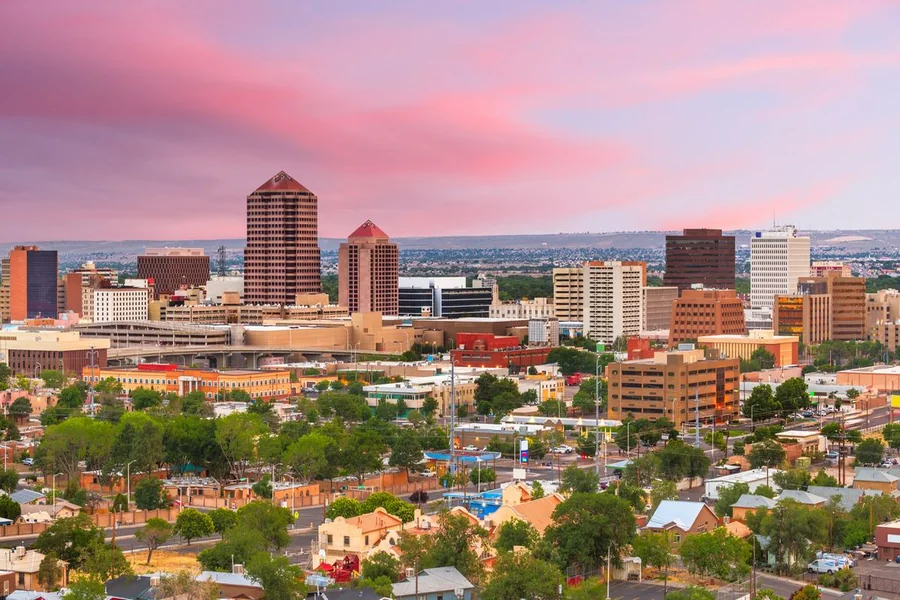
Where Americans spend their nights may have a measurable effect on the risks they encounter after dark. Violent crime, impaired driving, pedestrian deaths, binge drinking, drug overdoses and access to emergency medical care vary considerably from state to state, creating very different nighttime safety environments across the country.
A new analysis from Simmrin Law Group compared all 50 states across six measures of nighttime risk. The resulting 2026 Nightlife Risk Index places New Mexico at No. 1 with a risk score of 84.03, while Utah records the lowest score at 20.05.
New Mexico’s position is particularly notable because it does not stem from a single extreme statistic. The state has the nation’s highest violent-crime rate among the data used in the index, the highest late-night pedestrian fatality rate, the fourth-highest overdose mortality risk and an alcohol-impaired-driving fatality rate well above many other states.
The findings point to a broader pattern: nighttime risk is not simply a measure of crime. In several states, the greater threat after dark comes from the road, while in others, alcohol use, overdoses or limited emergency-care access push their overall risk higher.
The 10 States With the Highest Nighttime Risk
The Southwest and South feature prominently near the top of Simmrin Law Group’s ranking. New Mexico leads the country, followed by Arizona and South Carolina. Louisiana and Nevada round out the five highest-risk states.
| Rank | State | Nightlife Risk Score |
|---|---|---|
| 1 | New Mexico | 84.03 |
| 2 | Arizona | 79.39 |
| 3 | South Carolina | 78.67 |
| 4 | Louisiana | 78.01 |
| 5 | Nevada | 73.88 |
| 6 | Tennessee | 71.68 |
| 7 | Missouri | 68.47 |
| 8 | California | 66.84 |
| 9 | Colorado | 65.05 |
| 10 | Alaska | 65.00 |
The rankings highlight how different combinations of risk can lead states to similar overall scores. South Carolina, for example, does not have the country’s highest violent-crime rate, but it records the highest alcohol-impaired-driving fatality rate. Alaska has one of the lowest impaired-driving death rates included in the analysis but remains in the overall top 10 because of its performance on other indicators, including violent crime and overdose mortality.
At the opposite end of the index, Utah records the lowest overall risk score, followed by New Hampshire, Idaho and Virginia.
| Rank Among Lowest-Risk States | State | Nightlife Risk Score |
|---|---|---|
| 1 | Utah | 20.05 |
| 2 | New Hampshire | 24.49 |
| 3 | Idaho | 28.11 |
| 4 | Virginia | 28.37 |
| 5 | Minnesota | 31.17 |
| 6 | New Jersey | 31.73 |
| 7 | Maine | 32.45 |
| 8 | North Dakota | 33.16 |
| 9 | Nebraska | 33.67 |
| 10 | Iowa | 36.02 |
Utah stands out by a considerable margin and also records the lowest estimated binge-drinking rate included in the study, at 11.26%. Still, a low overall index score should not be interpreted to mean that nighttime incidents are rare or absent. The ranking measures states relative to one another across the selected indicators.
New Mexico Leads the Country in Two Major Risk Categories
New Mexico’s No. 1 overall ranking is supported by two particularly significant measures.
The state recorded 744.99 violent crimes per 100,000 residents, the highest rate in the dataset used by Simmrin Law Group. Alaska followed at 731.61, while Tennessee recorded 604.19, Arkansas 589.51 and Louisiana 504.25.
New Mexico also recorded the nation’s highest late-night pedestrian fatality rate, at 1.74 deaths per 100,000 residents for pedestrian deaths occurring between 10 p.m. and 4:59 a.m.
Mississippi ranked second at 1.60 deaths per 100,000, followed by Louisiana at 1.35, Nevada at 1.29 and Arizona at 1.13. Vermont recorded no late-night pedestrian deaths during the period analyzed, while Maine, North Dakota, New Hampshire and Iowa were also among the states with the lowest rates.
The results illustrate why New Mexico’s index score is substantially higher than that of many other states. Its risk is distributed across personal safety, transportation and substance-related measures rather than being concentrated in one category.
The Road Becomes a Major Source of Risk After Dark
Traffic data included in the study show how sharply road danger changes at night.
In 2024, there were 19,441 fatal motor-vehicle crashes between 6 p.m. and 5:59 a.m. Of those, 10,219 occurred on weekend nights and 9,222 occurred during the week. Urban areas accounted for 12,727 of the fatalities identified in the nighttime analysis, compared with 6,561 in rural areas.
Pedestrians faced an especially significant threat. The study reports 5,192 pedestrian deaths during nighttime hours in 2024, including 4,364 in urban locations and 785 in rural areas.
Alcohol also becomes a substantially larger factor once the sun goes down. Alcohol-impaired drivers were involved in 31% of fatal nighttime crashes, compared with 10% of fatal crashes during the daytime. Among single-vehicle fatal crashes, 32% of drivers were over the legal alcohol limit, compared with 14% in multivehicle crashes.
Hit-and-run crashes add another layer of risk. Simmrin Law Group’s analysis identified 2,113 nighttime fatalities involving hit-and-run crashes in 2024. More than 1,800 occurred in urban areas, and 1,150 happened on weekends.
South Carolina Has the Highest Impaired-Driving Death Rate
When alcohol-impaired-driving deaths are adjusted for population, South Carolina moves to the top.
| State | Alcohol-Impaired-Driving Deaths per 100,000 |
|---|---|
| South Carolina | 7.61 |
| Montana | 6.59 |
| Mississippi | 5.81 |
| Wyoming | 5.79 |
| Arizona | 5.53 |
New Mexico, despite ranking first overall, records a slightly lower impaired-driving fatality rate of 5.40 per 100,000 residents, placing it seventh on that individual measure.
The states with the lowest rates were Massachusetts at 1.40 deaths per 100,000, New York at 1.51, New Jersey at 1.58, Rhode Island at 1.71 and Alaska at 1.76.
This is one of the clearest examples of why a composite index can produce a different picture from any single statistic. Alaska’s impaired-driving fatality rate is among the lowest in the country, yet the state still ranks 10th overall for nighttime risk because it performs considerably worse on other measures.
Bars and Nightclubs Account for Thousands of Reported Crimes
Nightlife risk is not limited to the trip home.
Federal crime figures incorporated into Simmrin Law Group’s study show thousands of serious offenses were reported at bars and nightclubs between July 2021 and July 2024.
Among the venue-specific findings highlighted in the analysis:
- 52,215 aggravated assaults were reported at bars or nightclubs.
- 3,589 reported rape offenses occurred at those venues.
- 4,934 criminal sexual-contact offenses were reported.
- 5,865 robberies and 1,271 homicides were recorded.
- 13,672 drug or narcotic violations were reported.
- 8,415 motor-vehicle thefts occurred at bars or nightclubs.
Resolution rates also varied substantially by offense. According to the figures included in the study, 26.8% of rape cases and 25.5% of criminal sexual-contact cases were resolved, compared with 47.5% of aggravated assaults and 57.5% of homicides.
The data reinforce an important distinction in the index: nighttime danger includes both what happens inside nightlife establishments and risks encountered outside them, including parking areas, surrounding streets and transportation routes.
Iowa Leads the Nation in Binge Drinking
Alcohol-related road deaths are only one measure of drinking-related risk.
Iowa had the highest estimated binge-drinking prevalence in Simmrin Law Group’s dataset at 20.40%, followed almost identically by Montana at 20.39%.
| State | Estimated Binge-Drinking Rate |
|---|---|
| Iowa | 20.40% |
| Montana | 20.39% |
| Nebraska | 19.71% |
| North Dakota | 19.38% |
| Wisconsin | 19.06% |
Utah, which finishes last in the overall nighttime danger ranking, recorded the lowest estimated prevalence at 11.26%.
The index uses 2024 estimates for most states. Tennessee relies on the latest available 2023 figure because a comparable 2024 state estimate was unavailable.
West Virginia Has the Highest Overdose Death Rate
Substance-related risk shifts geographically when the focus moves from alcohol use to fatal drug overdoses.
West Virginia recorded the country’s highest 2024 overdose mortality rate at 48.9 deaths per 100,000 residents. Alaska ranked second at 45.1, followed by Washington at 37.6, New Mexico at 37.1 and Nevada at 35.9.
| State | Overdose Death Rate per 100,000 |
|---|---|
| West Virginia | 48.9 |
| Alaska | 45.1 |
| Washington | 37.6 |
| New Mexico | 37.1 |
| Nevada | 35.9 |
Nebraska recorded the lowest rate at 8.1 per 100,000, followed by South Dakota at 11.9, Iowa at 13.7, Arkansas at 13.9 and North Dakota at 14.8.
Timing also matters. Research incorporated into the study indicates approximately 34.4% of fatal overdoses occurred between 6 p.m. and 5:59 a.m., when fewer people may be nearby to recognize an overdose or intervene quickly.
Emergency Care Can Change the Risk After an Incident Occurs
The final piece of Simmrin Law Group’s index considers what happens after an emergency.
Maryland recorded the highest emergency-care risk score at 98.98, with Delaware, Connecticut and New Jersey also among the states facing the greatest combined emergency-care challenges in the index. North Dakota had the lowest emergency-care risk score at 1.02.
Hospital access also varied dramatically. South Dakota had the highest emergency-hospital density at 5.84 facilities per 100,000 residents, while New Jersey had the lowest at 0.60.
Average emergency-department times widened the gap further. Maryland recorded an average emergency-department visit of 243 minutes, compared with 105 minutes in North Dakota.
Those figures make emergency care particularly relevant to a nightlife index. A crash, assault, overdose or other injury does not end when the incident occurs. How quickly a person can reach and move through emergency care can affect the broader safety environment.
How Simmrin Law Group Built the Nightlife Risk Index
Simmrin Law Group compared the 50 states across six indicators, converting each measure to a 0-to-100 percentile risk score before combining the results. The District of Columbia and U.S. territories were excluded.
| Index Component | Weight | Measure |
|---|---|---|
| Violent crime | 25% | State violent-crime rate per 100,000 residents |
| Impaired-driving deaths | 20% | BAC .08+ fatalities per 100,000 |
| Late-night pedestrian deaths | 15% | Fatal pedestrians from 10 p.m. to 4:59 a.m. per 100,000 |
| Binge drinking | 15% | Adult prevalence |
| Overdose mortality | 15% | Age-adjusted deaths per 100,000 |
| Emergency care | 10% | Emergency-department density and median visit time |
Violent crime receives the greatest individual weight at 25%, followed by impaired-driving fatalities at 20%. Late-night pedestrian deaths, binge drinking and overdose mortality each account for 15%, while emergency care makes up the remaining 10%.
The methodology also reverses the hospital-density measure because greater emergency-care capacity is considered protective rather than harmful. After the six components are combined, states are sorted by overall score and separated into five 10-state risk bands.
The resulting ranking is a comparative measure, not an estimate of the probability that any individual will become the victim of a crime, crash or medical emergency.
What it does show is that nighttime risk takes very different forms around the country. New Mexico’s 84.03 score reflects a combination of violent crime, pedestrian danger, impaired-driving deaths and overdose mortality, while South Carolina stands out most for impaired-driving fatalities, Iowa for binge drinking, West Virginia for overdoses and Maryland for emergency-care risk.
Taken together, Simmrin Law Group’s findings suggest the danger associated with going out after dark extends well beyond the bar or nightclub itself. For many Americans, some of the greatest risks emerge on the street, behind the wheel, while walking home or during the critical period between an emergency and receiving medical care.


