
Depression that resists traditional treatment affects millions of people who have tried multiple medications without relief. Many individuals face difficult choices between continuing ineffective treatments, dealing with unwanted side effects, or exploring alternative approaches.
Transcranial Magnetic Stimulation (TMS) offers a non-invasive treatment option that uses magnetic fields to stimulate nerve cells in the brain, providing relief for treatment-resistant depression without the systemic side effects associated with medication. This FDA-cleared procedure requires no anesthesia, no sedation, and allows patients to return to their daily activities immediately after each session.
This article examines how TMS works, what makes it different from other depression treatments, and the evidence supporting its effectiveness. It also explores which conditions respond to TMS therapy, what patients can expect during treatment, and important safety considerations for those considering this approach.
TMS Therapy Explained: How It Works and What Sets It Apart
TMS therapy uses electromagnetic induction to deliver magnetic pulses that stimulate targeted brain regions involved in mood regulation. This FDA-approved treatment differs from medication by focusing on specific neural circuits without systemic side effects, and it comes in several protocol variations designed for different treatment needs.
Key Principles: Magnetic Pulses and Brain Stimulation
Transcranial magnetic stimulation operates through electromagnetic induction, where a TMS coil positioned near the scalp generates rapidly changing magnetic fields. These magnetic fields pass through the skull and induce small electrical currents in targeted brain tissue, typically the prefrontal cortex.
The magnetic pulses trigger nerve cells to fire, activating neural pathways that regulate mood and emotional processing. This repeated stimulation promotes neuroplasticity, the brain’s ability to form new neural connections and strengthen existing ones.
The electromagnetic coil delivers magnetic stimulation at specific frequencies and intensities calibrated to each patient’s needs. The process requires no anesthesia or sedation, as the magnetic fields penetrate brain tissue without causing discomfort to surrounding structures. Patients remain fully awake and alert during treatment sessions.
TMS vs. Medication: Non-Invasive, Targeted Treatment
Key Differences
|
Aspect |
TMS |
Antidepressants |
|
Delivery Method |
Magnetic pulses to brain |
Oral medication through bloodstream |
|
Target Area |
Specific brain regions |
Whole-body systemic effect |
|
Side Effects |
Mild scalp discomfort, headache |
Nausea, weight changes, sexual dysfunction |
|
Treatment Duration |
4-6 weeks of daily sessions |
Ongoing daily medication |
TMS provides non-invasive treatment without surgery or medication entering the body. The magnetic fields target precise brain areas involved in depression, unlike antidepressants that affect multiple body systems.
Patients can resume normal activities immediately after each TMS session. The treatment avoids common medication concerns like drug interactions, digestive issues, or the need for ongoing pharmaceutical management.
Types of TMS: rTMS, Deep TMS, and Emerging Protocols
Repetitive transcranial magnetic stimulation (rTMS) uses a figure-8 coil to deliver repeated magnetic pulses to surface brain regions. This standard approach has been FDA-approved since 2008 and remains the most widely available form of brain stimulation therapy.
Deep TMS (dTMS) employs an H-coil designed to reach deeper brain structures while stimulating broader neural networks. This technology can access regions beyond the reach of standard rTMS coils, potentially benefiting patients who need wider brain coverage.
Theta burst stimulation (TBS) represents a newer protocol that delivers magnetic pulses in specific patterns mimicking natural brain rhythms. Intermittent theta burst stimulation (iTBS) completes treatment in 3 minutes versus 30-40 minutes for traditional protocols, offering equivalent efficacy in shorter timeframes.
Accelerated TMS protocols like SAINT (Stanford Accelerated Intelligent Neuromodulation Therapy) deliver multiple sessions per day over one week instead of the standard 4-6 week course. These intensive approaches show promise for faster symptom relief in treatment-resistant cases.
The TMS Process: What to Expect During a Session
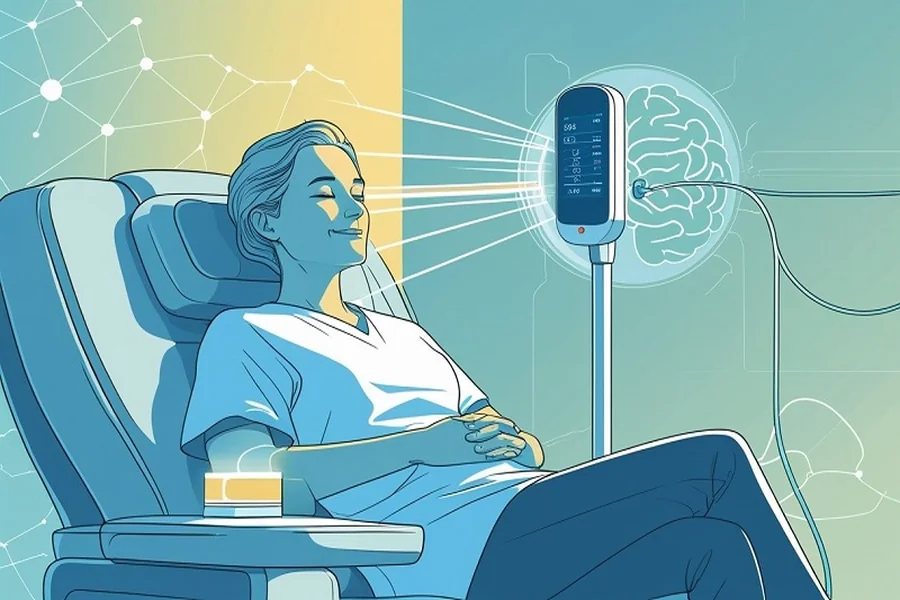
A TMS session begins with the patient seated in a comfortable chair while a technician positions the TMS machine’s electromagnetic coil against the scalp. The treatment team identifies the motor threshold by delivering test pulses until a finger twitch occurs, establishing the appropriate magnetic field strength for that individual.
During active treatment, the TMS coil delivers magnetic pulses in programmed patterns. Patients hear clicking sounds and feel tapping sensations on the scalp where the coil contacts. Each standard rTMS session lasts 30-40 minutes, while iTBS sessions take approximately 3 minutes.
Most patients receive treatment five days per week for 4-6 weeks, totaling 20-30 sessions. The repetitive TMS sessions build cumulative effects that strengthen neural pathways over time. Patients can read, listen to music, or watch videos during longer sessions, and they drive themselves home afterward without restrictions.
Powerful Results Without Medication: Effectiveness, Conditions Treated, and Safety
TMS has demonstrated significant clinical benefits across multiple psychiatric conditions, with FDA approval for several disorders and ongoing research expanding its applications. Studies show response rates of 50-60% for treatment-resistant depression, with many patients achieving complete remission of symptoms.
Who Benefits Most: Treatment-Resistant Depression and More
Patients with treatment-resistant depression represent the primary population benefiting from TMS therapy. This includes individuals with major depressive disorder (MDD) who have not responded adequately to at least two antidepressant medication trials at therapeutic doses.
Clinical trials indicate that TMS significantly outperforms successive medication trials in this population. Patients who have experienced intolerable side effects from antidepressants also find TMS particularly valuable, as it offers symptom relief without systemic medication effects.
Those with anxious depression—depression accompanied by significant anxiety symptoms—show favorable outcomes with TMS treatment. The therapy targets brain circuits in the dorsolateral prefrontal cortex (DLPFC) involved in mood regulation, addressing both depressive and anxious symptoms simultaneously.
Patients unable or unwilling to take psychiatric medications due to medical conditions, pregnancy concerns, or personal preferences represent another group that benefits substantially from this neuromodulation approach.
Conditions Treated: Depression, OCD, Anxiety, and Beyond
The FDA has approved TMS for major depressive disorder, obsessive-compulsive disorder (OCD), migraine headaches, and smoking cessation. TMS for depression targets the left DLPFC to enhance activity in underactive mood regulation circuits.
TMS for OCD uses different parameters and targets supplementary brain regions involved in compulsive behaviors. Treatment protocols for OCD typically involve stimulation of both the DLPFC and deeper cortical structures that regulate habit formation and repetitive thoughts.
Research supports TMS applications for several off-label conditions:
- Post-traumatic stress disorder (PTSD) with promising results in reducing intrusive symptoms
- Anxiety disorders as a standalone treatment or adjunct to cognitive behavioral therapy (CBT)
- Bipolar disorder depression phases with careful protocols to avoid triggering manic episodes
- Substance use disorders targeting craving-related brain circuits
Clinical trials continue investigating TMS effects on cognitive function, chronic pain, and various neurological conditions. The therapy modulates neurotransmitters including serotonin and dopamine, influencing brain chemistry without medication.
Measuring Success: Response and Remission Rates
Response rates for TMS in treatment-resistant depression range from 50-60%, meaning half of patients experience at least a 50% reduction in depression symptoms as measured by standardized scales like the PHQ-9. Remission rates—indicating complete or near-complete symptom resolution—reach 30-40% in most studies.
These outcomes compare favorably to medication switching strategies, which show response rates of approximately 25-30% after multiple failed trials. Multicenter trials demonstrate that TMS produces significantly better results than additional antidepressant attempts for patients who have not responded to prior treatments.
Treatment typically occurs over 4-6 weeks with daily sessions. Patients undergo regular symptom assessments to track improvement and adjust treatment parameters as needed.
For OCD, response rates approximate 40-50%, with symptom reduction becoming apparent after 3-4 weeks of treatment. Many patients maintain improvements for months following the initial treatment course.
Side Effects and Safety Considerations
TMS side effects remain generally mild and transient compared to psychiatric medications. The most common effects include headache and scalp discomfort at the stimulation site, occurring in 30-40% of patients but typically resolving within the first week.
Facial twitching or muscle contractions may occur during stimulation pulses, particularly when treating areas near the motor cortex. These sensations cease immediately when stimulation stops and do not indicate tissue damage.
Serious adverse events remain rare. Seizure risk exists at approximately 1 in 30,000 treatments, primarily in patients with predisposing factors. Careful screening excludes patients with seizure history, brain injuries, or metal implants in the head or neck region.
Most patients tolerate treatment well enough to complete the full course without interruption. Unlike antidepressants, TMS produces no weight gain, sexual dysfunction, sedation, or cognitive dulling. Insurance coverage for FDA-approved indications has expanded significantly, with many plans covering TMS after documented medication failures.