
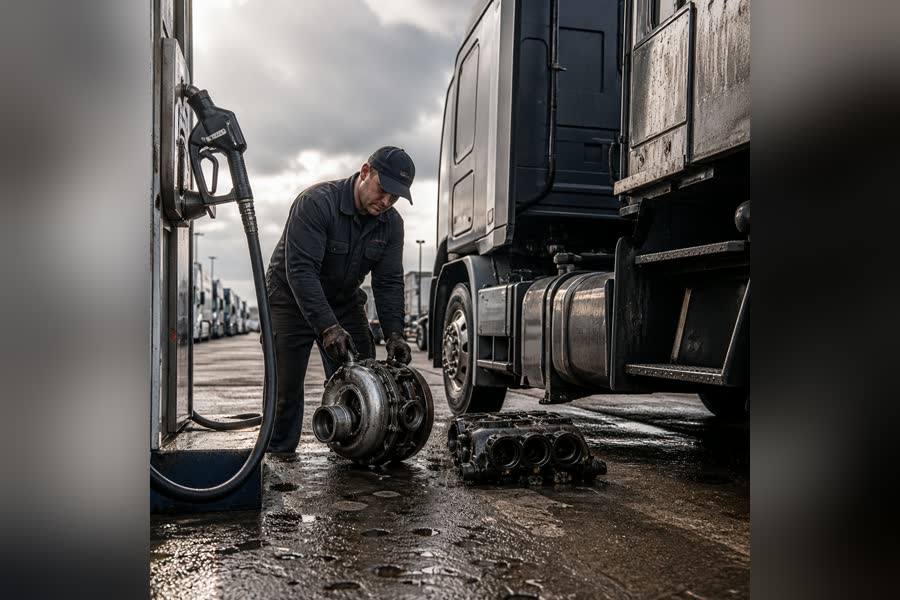
Electric drivetrains are winning headlines, but the trucks hauling gravel, the tractors pulling discs and the standby generators sitting behind hospitals are still compression-ignition machines. Most of them will stay that way for another decade or two. For the people who keep those machines running, two components decide almost everything about reliability, fuel burn and repair bills: the fuel injection pump and the turbocharger. Understand how they fail, and you stop replacing parts by guesswork.
A diesel engine has no throttle plate and no spark. Power is metered entirely by how much fuel is delivered, how finely it is atomized, and how much air is available to burn it. The injection pump handles the first two. The turbocharger handles the third. When either drifts out of spec, the other is forced to work in conditions it was never mapped for — which is why a tired turbo often gets blamed for smoke that is really a pump problem, and why a worn pump can cook a perfectly good turbo.
Injection pumps: rotary, inline and common rail
Rotary distributor pumps (the familiar VE and DPA-style units) use a single pumping element and a distributor rotor to feed each cylinder in turn. They are compact, mechanically governed on older applications, and sensitive to fuel quality because the rotor and hydraulic head run on diesel as their only lubricant. Inline pumps use one plunger-and-barrel assembly per cylinder in a camshaft-driven housing. They are heavier, far more serviceable, and the standard on medium and heavy truck engines for decades. Common rail systems split the job: a high-pressure pump builds rail pressure, and solenoid or piezo injectors decide timing and quantity electronically, with pressures that make older mechanical systems look gentle by comparison.
Each architecture fails differently. Rotary pumps leak at the shaft seal and lose cold-start timing advance. Inline pumps wear plungers and barrels, drop delivery valve sealing, and go out of calibration cylinder by cylinder. High-pressure common rail pumps are the ones that make the news — the well-documented issues surrounding CP4 pump failures across several diesel engine families are a useful case study in how one marginally lubricated component can send metal debris through an entire fuel system, taking injectors, rails and lines with it.
Turbochargers: simple in principle, unforgiving in practice
A turbo is a turbine wheel and a compressor wheel on a common shaft, spinning on a film of pressurized oil, often past 100,000 rpm. There is nothing exotic in the concept. The unforgiving part is that the center housing rotating assembly — the CHRA — depends on clean oil arriving at the right pressure and leaving without restriction. Starve it, coke it, or feed it abrasive debris, and the bearings go. Variable-geometry units add a vane mechanism in the exhaust stream that seizes with soot and ash if the engine spends its life idling or running short cycles.
Reading the symptoms before you buy parts
Most misdiagnoses come from treating smoke color and power loss as a single symptom. They aren’t. Work through the pattern:
- Black smoke under load, decent idle: usually an air-side problem — plugged filter, leaking charge pipe, failing turbo, stuck VGT vanes, or a clogged intercooler.
- White smoke on a warm engine: unburned fuel. Think injector atomization, timing retarded too far, or low compression on one cylinder.
- Blue smoke with rising oil consumption: check the turbo seals and the drain line before condemning rings.
- Hard starting hot but fine cold (or the reverse): typically pump internal leakage or a cold-start advance device, not injectors.
- Shrill whistle that changes pitch: a boost leak or a compressor wheel rubbing the housing.
- Rough idle that cleans up above 1,200 rpm: one weak injector or one worn pumping element.
Practical testing you can do on the yard
Before anything comes off the engine, spend an hour on measurements. They cost nothing and they settle arguments.
- Fuel supply first. Put a gauge on the inlet of the injection pump and watch it under load. A restricted filter or a collapsing suction line mimics pump wear perfectly, and no amount of new hardware will fix it.
- Check for air. A clear line section between filter and pump will show bubbles from a loose fitting or a weeping seal.
- Boost and backpressure together. Boost alone is half the story. High exhaust backpressure with low boost points at a restricted aftertreatment or a damaged turbine, not a lazy compressor.
- Shaft play by hand. With the inlet pipe off, feel axial and radial movement on the compressor nut. Any wheel-to-housing contact, or visible oil film on both sides, means the CHRA is done.
- Return flow from injectors. On common rail, measuring back-leakage per injector finds the one that is bleeding rail pressure in minutes.
- Cut open the filter. Glittery metal in the media is the giveaway that a high-pressure pump has already contaminated the system, which changes the repair plan entirely.
Bench calibration is the only honest way to confirm a mechanical pump’s output, which is why reputable rebuilt units come with flow data. If a seller cannot tell you what the pump was set to, you are buying a casting, not a calibrated assembly.
New, rebuilt or used: choosing the right part for the job
The decision usually comes down to how long the machine needs to last and how quickly it needs to move. A new unit makes sense on a late-model truck doing high annual miles. A properly rebuilt pump or turbo is the sensible middle ground for older equipment where new stock has dried up. Good used parts have a legitimate place too — a seasonal tractor, a generator that runs a few dozen hours a year, or a donor part to get a unit mobile while the correct replacement is sourced. What matters in all three cases is part-number discipline: casting numbers, calibration codes and application cross-references, because visually identical pumps can carry very different fuel settings.
That is where a specialist supplier earns its keep. Goldfarb & Associates, based in Rockville, Maryland, has been supplying new, rebuilt and used diesel fuel injection pumps — rotary, inline and common rail — along with injectors and nozzles, camshafts, ECMs, delivery valves, plungers and barrels since 1997, and its catalog of turbochargers for sale includes complete units and CHRA cartridges for operators who only need the rotating assembly. Its parts finder works from cross-reference numbers, which is genuinely useful when the tag on the pump is unreadable, and the company also buys rebuildable cores from remanufacturers, brokers and fleets — worth knowing if you have a shelf of take-off pumps gathering dust. Orders ship free ground over $50 within the 48 contiguous states, with worldwide delivery available.
Diesel maintenance in a mixed-fleet future
Fleet managers are increasingly running two technologies side by side, and the comparison sharpens how they think about diesel upkeep. Operators weighing up the best electric trucks for sustainable urban transport often find that short, predictable city routes suit battery vehicles while long-haul, high-torque and remote-site work stays diesel for now. The practical consequence is that the diesel side of the fleet gets older rather than smaller — and older engines need exactly the kind of pump and turbo knowledge that is slowly leaving the trade.
Three habits protect those assets: keep fuel clean and water-free, because every high-pressure fuel system depends on it; let turbos cool for a minute or two after hard work instead of shutting down hot; and treat oil change intervals as a bearing-life decision rather than a box to tick. Do that, and diagnose by measurement rather than by smoke color, and the pump and turbo stop being the parts you fear and become the parts you simply maintain.