
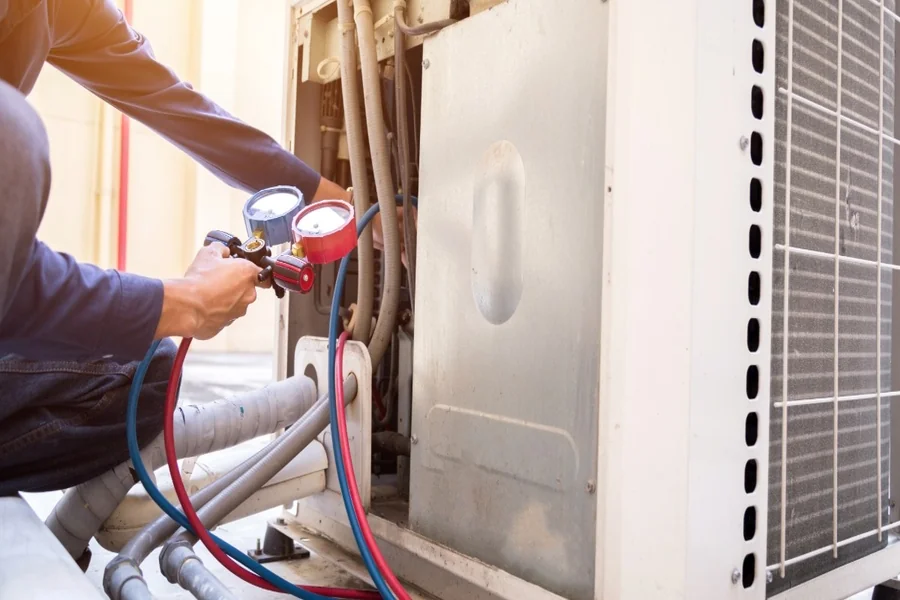
Refrigerant charge accuracy affects far more than how cold an air conditioner feels at the register. It influences system efficiency, compressor reliability, coil performance, humidity removal, and the overall stability of the refrigeration cycle. When the charge is too low or too high, the equipment may still run, but it often does so under strain that reduces comfort and increases wear. That is why HVAC contractors treat charge verification as a measured diagnostic procedure rather than a quick adjustment based on guesswork. A correct reading depends on system conditions, airflow, temperature relationships, and manufacturer data, all of which are considered together before any refrigerant is added or removed.
Precision in refrigerant management is vital for the long-term health of any split-system cooling unit. While simple issues like a clogged filter are easily identified, subtle charging errors require specialized diagnostic tools and technician expertise to detect before they lead to compressor burnout. Many homeowners only begin searching for ac repair near me once their system has completely failed, yet proactive verification of subcooling and superheat levels can prevent these costly breakdowns entirely. By ensuring the refrigerant levels match manufacturer specifications, contractors not only improve immediate cooling capacity but also significantly lower monthly energy consumption for the property owner. Proper charging remains a technical cornerstone of professional maintenance.
Achieving a precise measurement requires more than just high-quality gauges; the system must reach a thermal equilibrium. Technicians usually wait approximately fifteen to twenty minutes for pressures to stabilize after the compressor starts. During this window, environmental factors like humidity and outdoor ambient temperature are carefully monitored. Professionals can Learn more about these nuances by cross-referencing manufacturer-specific charging charts that account for seasonal variances. Neglecting this stabilization phase often leads to skewed data, potentially resulting in an overcharged system that puts unnecessary stress on the compressor and decreases overall efficiency.
What Contractors Check
- Confirming System Conditions First
Before verifying refrigerant charge, contractors usually confirm that the system is operating under conditions that allow meaningful readings. Refrigerant measurements taken too early, with poor airflow, or with dirty components can mislead the diagnosis. The contractor often begins by checking the air filter, blower operation, evaporator condition, condenser cleanliness, and thermostat setting to ensure the equipment is actually running in a stable cooling cycle. Indoor and outdoor temperatures matter as well, because refrigerant readings must be interpreted in relation to the system’s surrounding load. If return airflow is restricted or the evaporator coil is iced, pressure readings may suggest a charge problem even when airflow is the real issue. Contractors, therefore, try to eliminate these distortions before gauges are connected and calculations begin. This first stage is important because the refrigerant charge cannot be accurately assessed in isolation. The full system has to be operating in a condition close enough to normal that the readings reflect refrigerant behavior rather than unrelated performance faults.
- Measuring Pressures and Line Temperatures
Once stable operating conditions are confirmed, the contractor usually connects diagnostic instruments and begins measuring pressures and line temperatures. This step is more involved than simply reading gauge numbers. Suction pressure and liquid pressure are only part of the picture. The technician also measures suction line and liquid line temperatures, indoor return conditions, and outdoor ambient conditions to understand how the refrigerant moves through the system. These values are then used to calculate superheat or subcooling, depending on the metering device and the manufacturer’s charging method. A fixed-orifice system may rely more heavily on superheat targets, whereas a thermostatic expansion valve system is often evaluated based on subcooling. Contractors who discuss careful verification methods on https://www.semperfiheatingcooling.com/ may emphasize that accurate refrigerant diagnosis depends on matching measured values to the design of the system rather than assuming one approach fits every piece of equipment. This is where experience in procedure matters, because the numbers only become useful when they are interpreted in the right operating context.
- Comparing Results to Manufacturer Targets
After collecting field measurements, contractors compare those values to manufacturer charging information rather than relying on generic pressure rules. Two systems using the same refrigerant may still require different targets because coil design, metering method, and equipment capacity all influence proper performance. The charging chart or data plate provides the technician with a reference for what the system should be doing under specific indoor and outdoor conditions. Superheat and subcooling are valuable because they indicate whether the refrigerant is being fed and condensed in a controlled manner, not merely whether the pressure appears high or low. If the measured subcooling is below target, the system may be undercharged or experiencing another issue affecting liquid delivery. If it is too high, overcharge or restriction may be part of the problem. Contractors review these readings carefully because improper adjustments can move the system farther away from stable operation. Verifying charge accuracy is not about chasing one attractive number. It is about comparing multiple conditions against the equipment’s own performance standards and deciding whether the refrigerant level truly matches the system’s design.
- Checking for Conditions That Mimic Charge Problems
A careful contractor also looks for faults that can imitate incorrect refrigerant charge before making any final adjustment. Restricted airflow, duct issues, fouled coils, noncondensables, metering device problems, and even inaccurate instruments can all result in readings that appear to indicate overcharge or undercharge. A system with a dirty evaporator coil may show abnormal superheat because heat transfer has been reduced, not because refrigerant is missing. A blocked condenser can raise head pressure and distort subcooling interpretations without the charge being excessive. Leaks must also be considered, because adding refrigerant to a leaking system without identifying the cause only provides a temporary performance improvement. This is why contractors often verify temperature split, inspect coil surfaces, and evaluate overall system behavior along with refrigerant readings. The goal is to avoid treating refrigerant as the default answer every time pressures look unusual. Charge accuracy can only be confirmed when the technician is confident that other operational issues are not skewing the measurements. That discipline protects both the equipment and the quality of the diagnosis.
Accuracy Depends on Procedure
Verifying refrigerant charge accuracy is a methodical process that depends on more than gauge pressure alone. HVAC contractors check airflow, confirm stable operating conditions, measure temperatures and pressures, calculate superheat or subcooling, and compare those results to manufacturer specifications before making any corrections. They also look for faults that can imitate charge problems, so the system is not misdiagnosed. When adjustments are necessary, they are made slowly and confirmed with follow-up measurements rather than assumptions. That procedure matters because the refrigerant charge affects efficiency, durability, and overall cooling performance in ways that are easy to overlook when the system still appears to be running. Accurate verification protects the equipment by ensuring the refrigeration cycle is evaluated as a complete operating system.