
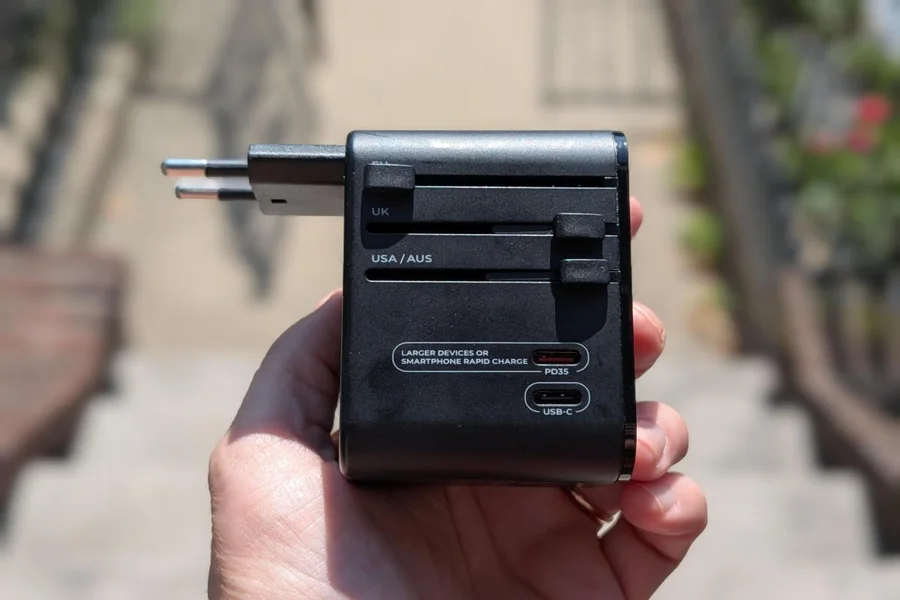
Plug shapes are not universal, and neither is voltage. There are roughly 15 plug types used worldwide, labeled Type A through Type O, while wall voltage swings from 120V in the United States to 230V across most of Europe and Asia. Get this wrong and you can kill a charger in seconds. This guide shows you exactly how to use a travel adapter, when you actually need one, and the two mistakes that quietly destroy devices.
What a travel adapter really does (and what it does not)
A travel adapter is a simple plug shape changer. It lets your two prong or three prong plug fit into a foreign wall socket. That is the whole job. It does not change the electricity flowing through it.
This is where most travelers get burned. An adapter reshapes the plug, but a voltage converter changes the actual power. If you plug a 120V only device into a 230V outlet using just an adapter, you send double the voltage into your electronics. That is how hair dryers pop and cheap chargers melt.
Step one: check your device before you buy anything
Flip your charger or device over and read the tiny print near the plug or on the power brick. You are looking for the input voltage rating.
- If it says “100 to 240V”, your device is dual voltage. It works anywhere in the world with only a plug adapter.
- If it says “120V” only, you need a voltage converter for high voltage countries, not just an adapter.
Good news for most people: phones, laptops, tablets, and modern camera chargers are almost always dual voltage. If a device says something like 100 to 240V, and possibly 50/60 Hz, you can use it almost anywhere. The danger zone is heating devices like hair dryers, straighteners, and kettles.
Step two: how to use a travel adapter, plug by plug
Once you know your device is safe for the destination, using the adapter takes seconds.
- Identify the plug type at your destination. The US uses Type A and B. The UK uses Type G. Most of continental Europe uses Type C and F.
- If you own a universal adapter, set the prongs. Push the slider that matches the correct region until the prongs click firmly into place.
- Plug your device cable into the adapter first.
- Insert the adapter into the wall socket until it sits flush and secure.
- Power on and confirm your device is charging normally.
Always plug your device into the adapter before the adapter goes into the wall. It is a small habit that reduces sparking and loose connections.
Universal adapter vs single country adapter
My honest opinion after years on the road: buy one good universal adapter and stop overthinking it. A single country adapter is cheaper, but you will buy a new one every trip. A quality universal model covers dozens of countries in one unit.
Look for built in USB-A and USB-C ports. Adapters with USB-A or USB-C ports let you charge multiple devices at once, which is great for travelers with phones, tablets, and smartwatches. That single feature can replace two or three separate chargers in your bag.
The two mistakes that kill devices
Mistake one: assuming an adapter changes voltage. It never does. Read the label first, every time.
Mistake two: trusting the ground pin. Some universal adapters use a plastic ground prong that does not conduct. On some models the ground prong is plastic and non conducting, existing only to open the shutters on a UK receptacle so the live pins can enter. For grounded, high draw appliances, use a proper grounded adapter instead.
Do not forget your other essential: staying connected
Power is only half the battle abroad. The moment you land, you also want data without hunting for a physical SIM card. Before a big trip I set up a travel eSIM so my phone connects the second I turn off airplane mode. If you want a plug and play option, this breakdown of Holafly travel eSIM carriers explains how to pick coverage by country. Pair a solid adapter with a working data plan and your phone is charged and online from minute one.
The same “check before you travel” logic applies whether you are flying or driving. If you are mapping out a long drive instead, this guide on choosing the right vehicle for a road trip pairs well with your packing list.
Frequently asked questions
Can I plug a US hair dryer into a European outlet with just an adapter?
No. A US only hair dryer is usually 120V. A European outlet delivers 230V, so you need a voltage converter or a dual voltage travel hair dryer instead.
Will a travel adapter charge my phone slower?
A basic adapter does not slow charging. Charging speed depends on your cable, the wall output, and your charger brick, not the plug shape.
Is one universal adapter enough for a multi country trip?
Usually yes. A quality universal adapter covers most destinations in a single trip, which is why it beats buying a new plug for each border.
What does “50/60 Hz” mean on my charger?
That is the electrical frequency. If your device lists both 50 and 60 Hz, it handles the frequency difference between the US and most of the world automatically.
Do I need an adapter for USB charging inside a hotel?
If your hotel has USB ports, you can skip the adapter for USB devices. For anything using a wall plug, you still need the correct plug shape.
Bottom line: read the voltage label, match the plug type, and carry one reliable universal adapter. Do that and you will charge everything, everywhere, without a single fried device.