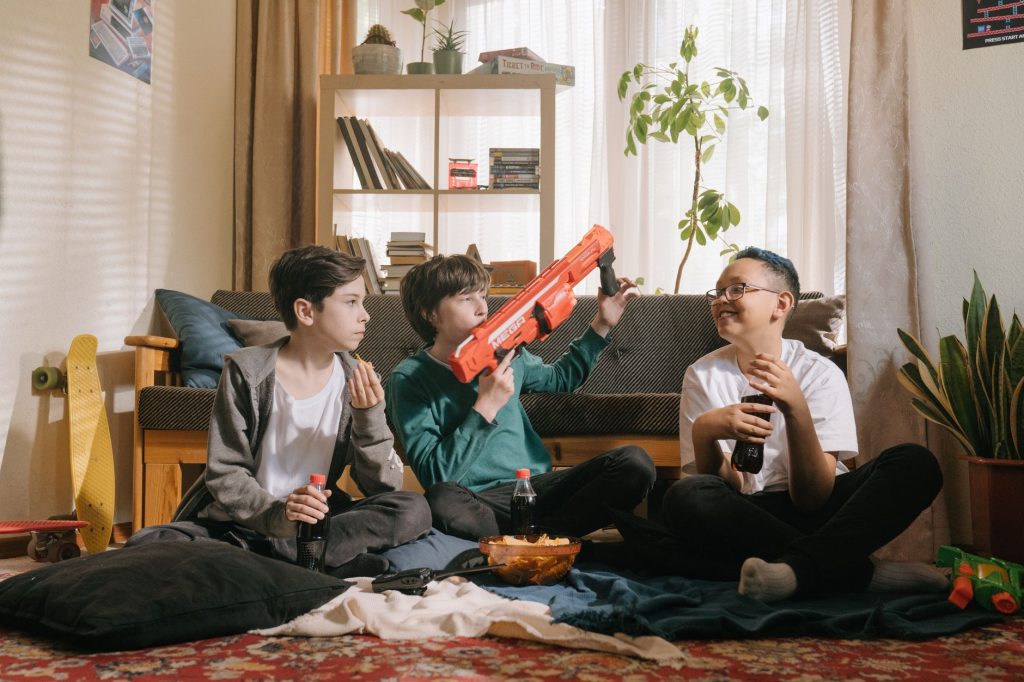
There’s a reason nerf guns keep showing up at birthday parties, office team-building days, and backyard get-togethers long after most people assume kids have outgrown them. Adults buy them too, sometimes more enthusiastically than the children they’re supposedly for. Part of it is nostalgia, sure, but the bigger reason is more practical: nerf guns solve a problem that a lot of group activities struggle with, which is getting a room full of people who don’t necessarily know each other well to actually interact instead of standing around making small talk.
Most party games ask people to either perform in front of a group or sit through something passive, like watching a movie or listening to someone explain the rules of a board game nobody asked for. A nerf battle skips both of those problems entirely. You hand someone a blaster, point them toward a pile of foam darts, and within about ninety seconds the social awkwardness has mostly dissolved because everyone’s too busy ducking behind furniture to worry about whether they’re being interesting.
Low Barrier to Entry, High Payoff
What makes this format work for such a wide range of groups is how little skill it actually demands. You don’t need coordination, athleticism, or any real practice to have a decent time with a nerf gun. A ten-year-old and a fifty-year-old can be on the same team and contribute roughly equally, which isn’t true of most physical games. Compare that to something like laser tag at a commercial venue, where the equipment can feel clunky and the sessions are often too short and too expensive to really let a group settle into a rhythm. A nerf setup at home or in a backyard costs a fraction of that and can run for as long as everyone’s having fun.
The safety factor matters here too, and it’s worth being upfront about it rather than glossing over it. Foam darts sting a little at close range but they’re not going to hurt anyone in any lasting way, which means the activity works for mixed-age groups without an adult hovering nervously nearby ready to intervene. Eye protection is still worth having on hand, especially for anyone shooting at closer distances, but beyond that the risk profile is about as low as physical group games get.
Team Dynamics Nobody Plans For
Something interesting happens once you split a group into teams for a nerf battle: people start forming strategies without anyone telling them to. Someone naturally ends up flanking while another person holds a defensive position behind a couch cushion fort. Kids who are usually quiet at parties sometimes turn out to be the best tacticians in the room, calling out enemy positions and directing teammates, and it’s genuinely one of the more fun things to watch as a bystander. This isn’t something you can really script into a party plan. It just tends to emerge once people have a shared, low-stakes objective and a reason to move around a space together.
Office team-building events have picked up on this too, not because HR departments have suddenly discovered nerf guns are trendy, but because the format does something structured trust-fall exercises rarely manage: it gets colleagues laughing at each other in a way that isn’t forced. There’s something about a coworker diving behind a filing cabinet mid-meeting-room ambush that breaks down formality faster than an icebreaker worksheet ever could.
Setting Up a Game That Actually Works
A few basics make the difference between a chaotic mess and an activity people talk about afterward. Define boundaries first, whether that’s a backyard, a basement, or a couple of connected rooms, and make sure everyone agrees on them before darts start flying. Simple objectives work better than complicated rule sets. Capture the flag translates almost perfectly to a nerf setting, and elimination-style free-for-alls are easy for even young kids to grasp within a round or two.
Cover matters more than most people expect going in. A space with a few couches, boxes, or other obstacles to duck behind turns a flat, boring shootout into something with actual tactical depth. If you’re hosting outdoors, trees and lawn furniture do the same job. It doesn’t need to be elaborate. Even a handful of cardboard boxes stacked in a yard changes how a game plays out.
One thing worth mentioning: don’t overthink the gear. You don’t need matching blasters or a huge dart stockpile to make this work. A mismatched collection borrowed from a few different households is honestly part of the charm, and running out of darts mid-round just means a mad scramble to collect them off the ground, which somehow always ends up being its own fun bit of chaos.
Why It Keeps Working
Group games come and go in popularity, but nerf battles have stuck around for a reason that has less to do with the toys themselves and more to do with what they enable. They give people permission to be a little silly, to move around, and to work toward something together without the pressure of a performance or a scoreboard that actually matters. Whether it’s a kid’s birthday party, a work retreat trying to get people to loosen up, or just a random Saturday with friends who need an excuse to be outside, a round of nerf guns tends to do more for a group’s energy than almost anything else you could plan for the same amount of effort and cost.