
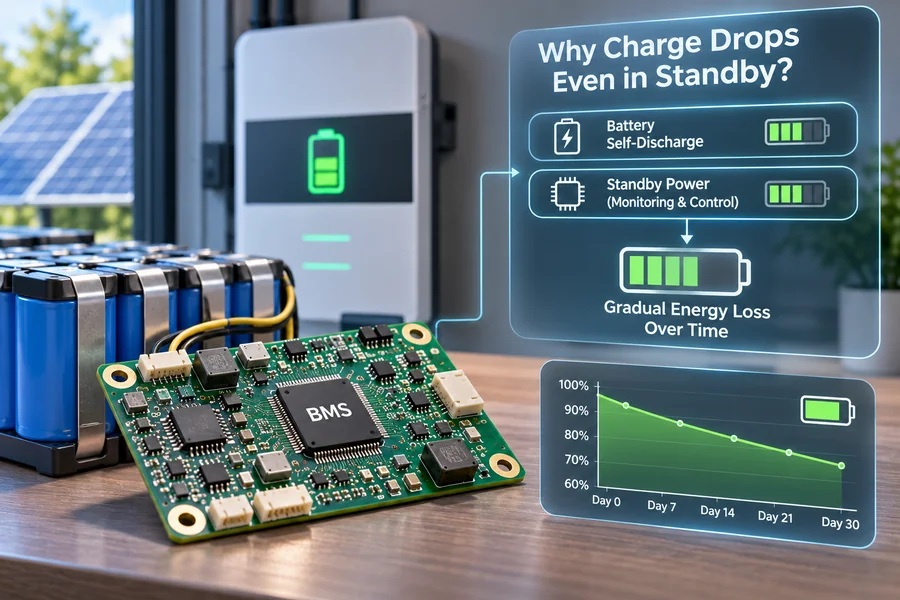
A home battery system may sit unused for several days, yet its available charge can still decrease. The same thing happens with portable power stations and backup battery equipment. Understanding these losses is an important consideration in PCB manufacturing services for battery-powered equipment. While some energy loss comes from the battery itself, the electronics that monitor and manage the system may also consume power continuously. These circuits must remain responsive to important battery conditions without using more energy than necessary. This creates a particular challenge for energy storage PCB assembly, where standby efficiency and essential monitoring functions must be carefully balanced.
Why Stored Energy Does Not Stay Constant
A battery does not preserve its charge indefinitely.
Even when disconnected from external loads, batteries experience self-discharge due to internal electrochemical processes. The rate depends on battery chemistry, temperature, age, and other operating conditions.
However, an energy storage system is more than a collection of battery cells.
It also contains electronics responsible for monitoring voltage, measuring temperature, controlling power distribution, and communicating with other parts of the system.
Some of these circuits continue operating when the system is not actively supplying electricity.
As a result, the energy lost during storage may come from both battery self-discharge and the power consumed by connected electronics.
Battery Management Systems Cannot Simply Switch Off
A battery management system, or BMS, helps monitor and manage important battery operating conditions.
Depending on the design, it may measure individual cell voltages, monitor temperatures, estimate battery status, and control protection devices.
These functions are important because batteries must remain within their specified operating limits.
However, monitoring requires electrical power.
Even when the main output is disabled, selected BMS circuits may need to remain active or wake periodically to perform measurements.
The engineering challenge is to reduce unnecessary consumption without removing the monitoring and protection functions required by the system.
This is why low-power operation must be considered during the design of battery management electronics.
Sleep Modes Help Reduce Unnecessary Consumption
Many battery-powered electronic systems use different operating states to manage energy consumption.
During normal operation, the controller may continuously process measurements and communicate with other devices.
When the system becomes inactive, it may enter a lower-power state.
In this mode, selected circuits can reduce their activity while essential monitoring functions remain available.
For example, a controller might stop frequent communication updates and wake periodically to check battery conditions.
Other systems may use dedicated low-power monitoring circuits that remain active while the main processor sleeps.
The appropriate approach depends on the battery chemistry, system architecture, safety requirements, and intended operating conditions.
A sleep mode is useful only if the system can still detect and respond to conditions that require attention.
Small Electronic Loads Can Add Up Over Time
Standby power consumption may appear insignificant when compared with the energy delivered during normal operation.
However, a small continuous electrical load can become noticeable over weeks or months.
Consider an electronic monitoring circuit that consumes 0.5 watts continuously.
Over 30 days, that circuit would use approximately 0.36 kilowatt-hours of energy.
For a large stationary battery system, this may represent a relatively small portion of total capacity.
For a compact portable power station or a small backup battery, standby consumption can have a greater effect on how much energy remains available.
This is why engineers evaluate both active power requirements and the energy consumed when a product is waiting to be used.
PCB Design Influences Standby Efficiency
The power consumed by battery management electronics depends on several design decisions.
Voltage regulators, microcontrollers, sensing circuits, communication interfaces, and supporting components all contribute to the overall power budget.
For example, a voltage regulator may have a small quiescent current that continues flowing even when the connected circuit is lightly loaded.
Similarly, an unnecessary pull-up path or a peripheral that remains enabled can increase standby consumption.
PCB layout also matters, particularly for sensitive measurement circuits and designs where leakage currents must be controlled.
Component selection, circuit architecture, firmware, and manufacturing quality must work together to achieve the intended low-power performance.
Manufacturing Consistency Matters for Low-Power Electronics
Once a low-power circuit has been designed, its performance must be reproduced during manufacturing.
An unapproved component substitution could change quiescent current or operating behavior. Assembly contamination may also contribute to leakage problems in sensitive circuits under certain conditions.
Appropriate component control, assembly processes, and inspection help reduce these risks.
For battery management boards, testing requirements may include verifying power consumption in different operating states.
A board that functions correctly during active operation may still consume more current than intended while sleeping.
This means low-power performance should be evaluated against defined specifications rather than assumed from successful power-on testing alone.
Standby Testing Should Reflect Real Usage
Measuring standby current at one moment does not always describe how much energy a system will consume over time.
Some devices alternate between sleep and active monitoring states.
Others periodically activate communication interfaces, perform measurements, or update internal records.
These activities can create short increases in current consumption.
Engineers may therefore evaluate average power consumption over a representative operating cycle rather than relying only on a single instantaneous reading.
Longer-duration testing can also help identify unexpected wake-up events or circuits that fail to enter the intended low-power state.
For complete energy storage products, these measurements should be considered alongside battery self-discharge and other system-level losses.
Conclusion
Energy storage systems can lose charge even when they are not supplying power to external equipment.
Some of this loss is an unavoidable characteristic of battery chemistry, while another portion comes from the electronics responsible for monitoring and managing the system.
Efficient standby operation requires careful circuit design, appropriate low-power components, and well-defined operating states.
Reliable PCB manufacturing services help reproduce these designs consistently, while controlled energy storage PCB assembly supports the electronic functions needed for battery monitoring and power management.
For energy storage products, conserving power is not only about improving efficiency during use. It also means protecting the energy that customers expect to be available when they need it.