
The world of trading can be both thrilling and overwhelming. For many aspiring traders, the promise of trading with significant capital is enticing but often out of reach. This is where proprietary trading firms, or prop firms, come into play. Prop firms allow traders to access larger funds than they personally have, share profits, and develop their skills in a structured environment.
But a common question remains: are prop firms legit ? Many traders are understandably cautious. Stories of scams and misleading firms exist, so understanding how prop firms operate and identifying trustworthy ones is essential. In this comprehensive guide, we will explore everything about prop firms, their business models, risks, advantages, and why firms like PropFunding are considered legitimate and trader-friendly.
What Is a Prop Firm?
A proprietary trading firm is a company that provides traders with capital to trade financial markets, such as forex, stocks, or commodities. Traders use the firm’s money rather than their own, and in return, share a portion of their profits with the firm.
Prop firms essentially act as investors in a trader’s ability. They assume some risk by providing capital but limit losses through strict trading rules, such as drawdown limits and daily risk thresholds. The key benefit for traders is access to substantial funds with minimal personal investment. Understanding how to build a trading plan is equally important, as a well-defined strategy helps traders stay within these risk limits and maintain consistent performance.
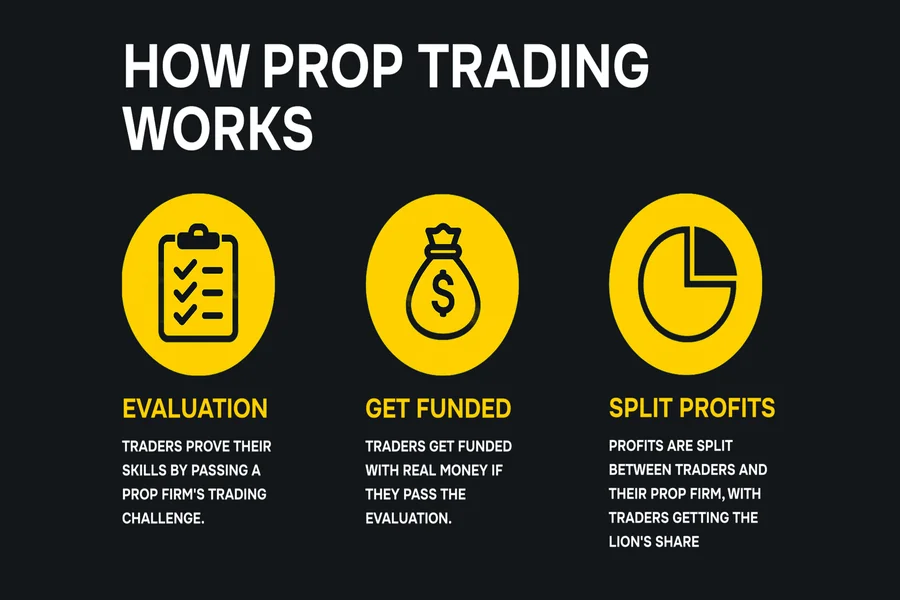
How Prop Firms Work
Prop firms usually follow a clear process:
- Evaluation or Challenge: Traders must pass a trading test or challenge, demonstrating skill, risk management, and consistency.
- Funding Approval: Once the challenge is passed, traders gain access to firm capital.
- Profit Sharing: Traders share profits with the firm, often retaining a large portion themselves.
Some firms require an upfront fee for the evaluation, while others, like PropFunding, have innovated with a “pass first, then pay” model, reducing financial barriers.
Are Prop Firms Legitimate Businesses?
Yes, many prop firms are legitimate. They are professional businesses that generate revenue from evaluation fees, profit sharing, and trading data. Legitimate prop firms operate transparently, provide clear rules, and pay traders consistently.
However, it is important to differentiate between legitimate firms and scams. Some firms may exploit inexperienced traders by charging high fees, offering impossible targets, or providing unclear contracts. Due diligence is critical before committing to any prop firm.
Signs of a Legitimate Prop Firm
To determine if a prop firm is trustworthy, look for these signs:
- Transparent Fees and Rules: Legitimate firms clearly communicate evaluation costs, profit splits, trading rules, and payout schedules.
- Clear Challenge Requirements: Profit targets, drawdown limits, and minimum trading days should be openly stated.
- Consistent Payouts: Reliable firms have a track record of paying their traders regularly.
- Educational Support: Resources, coaching, or trading communities are a good indicator of a serious firm.
- Positive Reputation: Reviews, testimonials, and community feedback can provide insights into a firm’s legitimacy.
PropFunding is an excellent example. Their “Pass First, Then Pay” model allows traders to enter challenges without upfront fees. Only after passing do traders pay a small activation fee to access funded accounts, making it fair and accessible.
Why PropFunding Is Different
PropFunding’s model changes the traditional dynamics of prop trading.
- No Upfront Fees: Traders can join challenges without paying anything initially.
- Pay Only After Passing: Activation fees are charged only after successful completion of the challenge.
- Profit Sharing Up to 80%: Traders keep the majority of profits, encouraging disciplined trading.
- Gamified Learning and Community Insights: Access to trading data from other top traders helps improve strategies.
This model reduces financial risk, focuses on skill-based success, and ensures both traders and the firm benefit together.
Evaluating a Prop Firm Before Joining
Before committing, consider the following steps:
- Research Reputation: Look for reviews, testimonials, and social proof.
- Understand Terms: Be clear on profit splits, drawdowns, and withdrawal rules.
- Check Payout History: Ensure the firm regularly pays traders.
- Look for Demo or Trial Access: Some firms allow trial accounts to test their platform risk-free.
- Assess Transparency and Support: Good firms offer responsive customer support and educational resources.
Choosing a reliable prop firm is crucial. PropFunding’s transparency and trader-friendly model make it a strong candidate for both new and experienced traders.
Common Myths About Prop Firms
There are several misconceptions about prop firms:
- Myth 1: All Prop Firms Are Scams
Many prop firms are legitimate and have funded traders for years. - Myth 2: You Need Large Capital to Start
Legitimate prop firms provide their own capital; your own funds are rarely required to pass challenges. - Myth 3: Traders Always Lose Their Money
Reliable firms protect trader capital with clear rules, making losses part of learning, not exploitation. - Myth 4: Only Experts Can Join
Many firms support traders of all skill levels, focusing on discipline and strategy over experience.
PropFunding addresses all these myths with its fair, transparent model, making it more accessible for serious traders.
How Prop Firms Make Money
Prop firms earn revenue mainly through:
- Evaluation Fees: Paid to access challenges, though not all firms require upfront fees.
- Profit Sharing: A percentage of earnings from funded traders.
- Trading Data Insights: Anonymised trade patterns can improve firm strategies or support algorithmic trading.
PropFunding earns primarily from traders who succeed, not from those who fail, making its business model fairer and trader-focused.
Risks in Prop Trading
While many prop firms are legitimate, there are inherent risks:
- Unrealistic Targets: Some firms set profit goals that are difficult to achieve.
- High Upfront Costs: Evaluation fees can be prohibitive.
- Hidden Rules: Contracts may include clauses that limit withdrawals or add extra charges.
- Psychological Pressure: Trading with firm capital can add stress.
Firms like PropFunding minimise these risks by providing a no-upfront-fee challenge and clear, fair rules.
Advantages of Legit Prop Firms
Legitimate prop firms offer numerous benefits:
- Access to Capital: Trade larger accounts than you could personally afford.
- Professional Trading Environment: Learn risk management with larger funds.
- Profit Potential: Share profits while reducing personal financial exposure.
- Skill Development: Coaching, forums, and challenge feedback help traders improve.
These advantages allow traders to gain experience, confidence, and a path to professional trading.
Step-by-Step Preparation to Pass Challenges
Passing a prop firm challenge requires planning and discipline:
- Study the Rules: Know profit targets, drawdowns, and trading restrictions.
- Develop a Strategy: Prepare a plan that fits your trading style and challenge conditions.
- Risk Management: Never exceed position size limits or daily drawdowns.
- Consistency: Focus on steady gains rather than chasing large profits.
- Track Performance: Review trades daily and adjust strategies carefully.
- Stay Disciplined: Emotional control is critical to avoid impulsive decisions.
PropFunding’s model allows traders to focus on these elements without the pressure of upfront fees.
PropFunding’s Unique Advantages
PropFunding stands out for several reasons:
- Fair Activation Fees: Only pay after passing the challenge.
- High Profit Share: Keep up to 80% of profits.
- Community Insights: Learn from top-performing traders.
- Gamified Experience: Arena modes reward top performers with bonuses and recognition.
These features make PropFunding a prime example of a legitimate and trader-friendly firm.
FAQs About Prop Firms
Q1: Can beginners succeed in prop trading?
Yes. Firms like PropFunding provide structured challenges to help all skill levels improve.
Q2: How do profit splits work?
Traders typically keep a majority of profits, often up to 80%.
Q3: Do you lose money if you fail the challenge?
With PropFunding, you pay nothing if you fail — making it low-risk.
Q4: Are withdrawals straightforward?
Legitimate firms provide clear withdrawal rules. PropFunding pays every 14 days after initial verification.
Q5: Are all prop firms the same?
No. Some require large upfront fees, some offer free trials, and rules differ. Always research before committing.
Comparing Prop Firms
When choosing a prop firm, consider:
| Feature | Traditional Firms | PropFunding |
| Upfront Fee | Often high | None (pay after passing) |
| Profit Share | 50–70% | Up to 80% |
| Challenge Difficulty | Can be very strict | Realistic, fair targets |
| Educational Support | Varies | Extensive community and data insights |
| Transparency | Sometimes unclear | Clear rules, payout schedule |
This table highlights why PropFunding is considered legitimate and trader-friendly.
Are Prop Firms Legit? Final Thoughts
The question of prop firms legit can be answered affirmatively for many firms. Legitimate prop firms provide traders with real capital, profit-sharing opportunities, and a path to professional trading.
Key factors for legitimacy include transparency, fair challenges, consistent payouts, and trader-focused policies. PropFunding’s model — free entry, pay after passing, high profit share, and educational support — exemplifies a legitimate prop firm prioritising fairness and skill.
For aspiring traders, joining a trusted prop firm can provide valuable experience, reduce personal risk, and offer a platform for long-term growth.