A dark backyard gets used one way: you walk the dog, you check the grill, you go back inside. That is it. When I started paying attention to how often my own family stepped outside after sunset, the answer embarrassed me. Roughly ten times a month in summer, almost never in winter. Not because we did not want to be out there. Because we could not see anything.
Lighting fixes that. Not expensive lighting, and not a floodlight bolted to the eaves. The right low-voltage layout changes what a yard can be after dark, and it is a smaller project than most people assume. Here is what actually matters when you plan it.
Why Good Yard Lighting Is Mostly About Where You Put Things
Most homeowners think the fixture is the decision. It is not. Placement is. A $40 fixture aimed at a tree trunk looks better than a $300 fixture aimed at nothing.
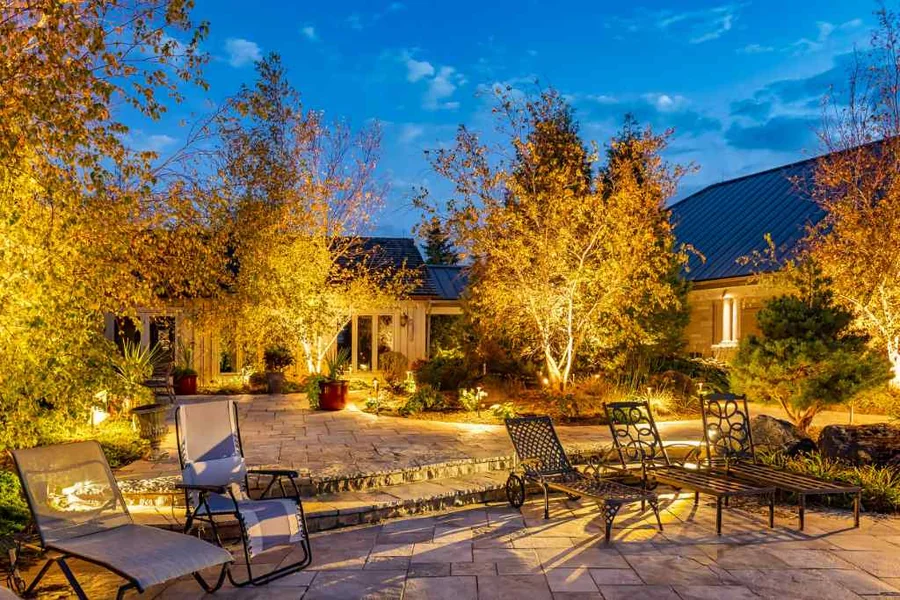
Think about your yard the way a stage director thinks about a set. You pick three or four features worth seeing, then you light those and let everything else fall into shadow. The darkness is not the problem you are solving. It is the material you are working with.
Walk your property at night with a flashlight and note what you want people to notice. A mature oak. A stone wall. The step from the patio down to the lawn, which somebody will trip on eventually. Those become your focal points.
The Four Lighting Jobs Every Yard Needs
Skip the fixture catalog for a minute. Every outdoor lighting plan does four separate jobs, and mixing them up is why so many yards end up looking like a parking lot.
- Path edges, stairs, and grade changes. This is the non-negotiable layer.
- A few well-placed lights discourage somebody from crossing your property line. A lot of light does not do more than a little.
- Uplighting a facade, washing a wall, or grazing a fence so the material reads at night.
- Fire pit glow, string lights over a patio table, the warm pool of light where you actually sit.
Do them in that order. Safety first, mood last. Most disappointing installations I have seen were built for mood and never addressed the step by the back door.
What to Know Before You Buy Fixtures
Low-voltage systems run on 12 or 24 volts and use a transformer that plugs into a standard outdoor outlet. That is the whole premise. It is safe to work with, and you can add fixtures later without tearing anything up. The Department of Energy covers the basics of residential lighting efficiency if you want to compare fixture types before you commit to a wattage.
Copper and brass fixtures cost more up front and hold up far better in humid coastal air. Aluminum is cheaper and cheaper for a reason. If you live anywhere near salt water, that difference shows up within a couple of seasons, and it shows up as pitting and flaking, not a slow graceful fade.
Warm color temperature matters more than brightness. Around 2700K reads like incandescent light. Anything above 3500K turns your landscaping blue and cold. The safety science organization UL maintains the standards that outdoor electrical products are tested against, so check for that mark on anything you bury or plug in.
A Simple Planning Walkthrough You Can Do This Weekend
You do not need a designer to sketch a first pass. Give this an hour after dark.
- Stand at every entrance to your yard and look outward. Note what your eye hits first.
- Mark trip hazards with a piece of tape: step edges, uneven pavers, roots.
- Pick three vertical features you want lit. Trees, columns, and walls work best.
- Sketch the run from your outlet to the farthest fixture. Keep it under about 100 feet per run if you can.
- Count fixtures. Ten to fifteen is a typical starting point for a half-acre yard.
Then get a quote. A professional installer will usually catch two or three things you missed, particularly around voltage drop on long runs and where to hide the transformer.
Common Mistakes That Make a Yard Look Worse
Up-lighting every tree in the yard. You end up with a runway, not a garden. Pick two or three.
Pointing fixtures at the house from the lawn. That puts glare in your eyes every time you look outside. Aim away from sightlines or from the angle a person actually sits.
Using one giant floodlight for everything. Bright, flat light kills depth and makes a yard feel like a car dealership.
Setting the transformer and forgetting it. As fixtures age and you add more, voltage drops and the far end of the run dims. That is normal and it is adjustable.
Buying fixtures before you plan the layout. This is the most common one, and it is the reason so many projects stall with a box of lights in the garage.
What a Professional Brings That a Kit Does Not
The kits at the hardware store work for a path and a couple of accent lights. Beyond that, three things get hard fast: voltage calculations, cable routing underground, and making the whole thing look intentional rather than installed.
If you live in a coastal market, salt air and storm season add a layer of complexity, and fixture selection matters more than it does inland. That is why a lot of homeowners in Southwest Florida end up sourcing custom outdoor lighting fixtures in Naples FL rather than a box kit, because marine-grade housings and proper sealing are not something you can retrofit later.
Hidden cable, uplight angles that miss the neighboring windows, and a transformer sized with room to grow. Those details are what separate a yard that looks good at night from one that looks like a project.
What It Costs to Run, Month to Month
This part surprises people. Modern LED landscape fixtures draw very little. A typical 12-fixture system running five hours a night uses about as much electricity as a single refrigerator bulb. Compare that with the older halogen setups and the difference is dramatic.
Set the whole system on a photocell or a timer and you will never think about it again. Just make sure the timer matches when you actually use the yard, not some default schedule. There is no point lighting a patio from 6 p.m. if you only sit out there after 9.
If you want a broader frame on how people use residential outdoor space, the National Park Service writes about the value of time spent outdoors, and the same reasoning applies at a much smaller scale in your own yard.
Start With One Corner
Do not light the whole property at once. Pick the corner you use most, the patio or the fire pit area, and light that properly. Live with it for a month. You will learn more about what your yard needs from watching how you move through it than from any layout sketch.
The point is not a magazine photo. It is a yard you walk into at 9 p.m. without feeling like you are trespassing in your own space.
So here is the question worth sitting with: what is your yard for after dark? If the honest answer is “nothing,” you have a lighting problem, and it is a solvable one.