
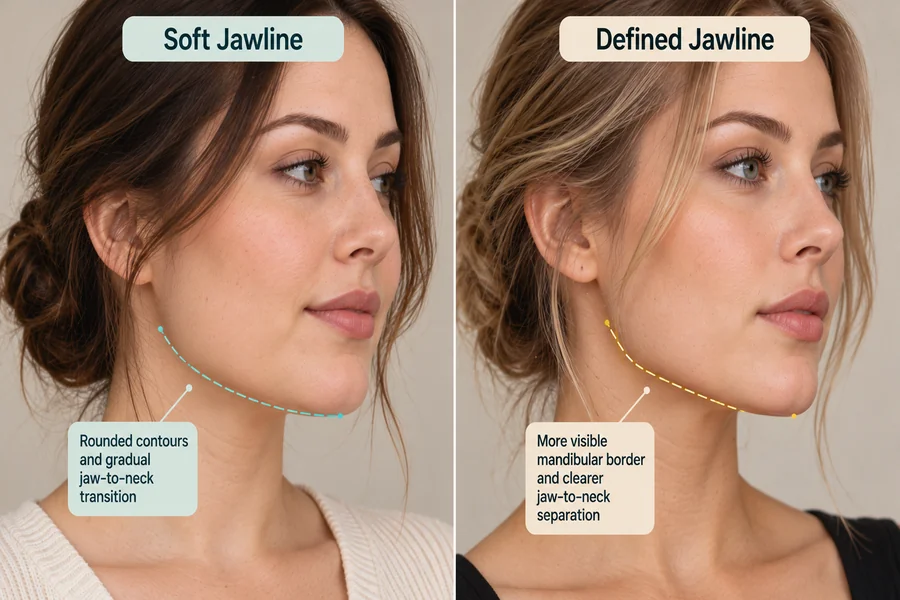
A soft jawline has gentle curves rather than sharply defined angles, creating a smooth transition between the chin, lower face, and neck. While some people prefer a sculpted jaw, others appreciate softer contours that complement their facial features.
Understanding what causes a soft jawline can help you embrace your natural appearance or explore ways to enhance its definition. Genetics, aging, skincare, styling, and cosmetic treatments all influence how the lower face looks.
Soft Jawline vs. Defined Jawline: What’s the Difference?
The main difference is how clearly the lower edge of the jawbone separates the face from the neck.
A soft jawline typically has rounded contours, subtle angles, and a gradual transition beneath the chin. A defined jawline has a more visible mandibular border and greater separation between the chin and neck.
Neither is inherently more attractive. Facial harmony depends on how the jawline relates to the cheeks, chin, and other features.
Jawline definition is influenced by genetics, bone structure, chin projection, facial fat, skin elasticity, dental alignment, and posture.
A naturally soft jawline does not necessarily indicate a health concern.
What Determines Your Jawline Shape?
The mandible forms the structural foundation of the lower face. Its visible outline depends on bone, muscles, fat, and skin.
Bone Structure and Chin Projection
Jaw width, chin projection, and mandibular angles influence whether the lower face appears rounded, tapered, or angular.
A smaller or less projecting chin can create a softer profile even without substantial fat beneath the jaw.
Facial Muscles and Fat Distribution
Masseter muscles contribute to lower-face width. Larger muscles may create a squarer appearance.
Subcutaneous fat, particularly beneath the chin, can soften the transition between the jaw and neck.
Skin Thickness and Elasticity
Skin firmness determines how closely facial contours follow underlying structures.
Reduced elasticity can make the jawline less distinct even when bone structure remains unchanged.
Explore Your Facial Features With Facefy
Understanding your facial proportions provides a useful foundation for choosing hairstyles, grooming techniques, and other appearance-related options.
Facefy offers facial analysis tools that help users explore face shape, proportions, and personalized beauty insights.
Rather than treating sharp jawlines as a universal ideal, Facefy provides a starting point for understanding how your natural features contribute to overall facial harmony.
Why Does the Jawline Become Softer With Age?
Jawline definition can gradually change throughout adulthood.
Bone remodeling: Age-related skeletal changes may affect chin projection and structural support.
Collagen and elastin changes: Reduced skin elasticity can contribute to sagging.
Fat redistribution: Changes in facial fat compartments may make jowls more noticeable.
Muscle and connective tissue changes: Supporting tissues influence the jaw-to-neck transition.
Smoking, sun exposure, and substantial weight fluctuations may also contribute to visible aging.
Genetics and Naturally Soft Jawlines
Genetics strongly influences jaw width, chin shape, and lower-jaw positioning.
Inherited characteristics may include a tapered mandible, rounded jaw angle, smaller chin, or fuller cheeks.
Dental development and skeletal positioning also influence facial appearance.
However, having a soft jawline does not automatically indicate a dental problem.
Common Causes of a Soft or Weak Jawline
A soft jawline describes visible contours, while a weak or recessed jaw may indicate limited skeletal projection.
Submental Fat and Double Chin
Fat beneath the chin can reduce jawline definition regardless of overall body size.
Skin Laxity and Jowls
Loose skin and descending facial tissues can obscure the jawbone’s outline.
Chin Position and Dental Alignment
A recessed chin or significant bite discrepancy may influence the lower-face profile.
Posture and Neck Position
Forward head posture can change the jaw-to-neck angle in photographs without altering bone structure.
How to Enhance a Soft Jawline Naturally
Several everyday approaches can influence visible definition without permanently changing facial anatomy.
Maintain a Healthy, Sustainable Weight
When submental fullness relates to overall body fat, gradual weight management may reduce its appearance.
However, targeted exercises cannot selectively burn chin fat.
Try Gentle Facial Massage
Massage and gua sha may temporarily reduce puffiness but cannot permanently remove fat or tighten loose skin.
Improve Your Posture
Comfortable head and neck alignment can improve the appearance of your profile.
Choose Flattering Hairstyles
Face-framing layers, textured bobs, and crown volume can balance softer lower-face contours.
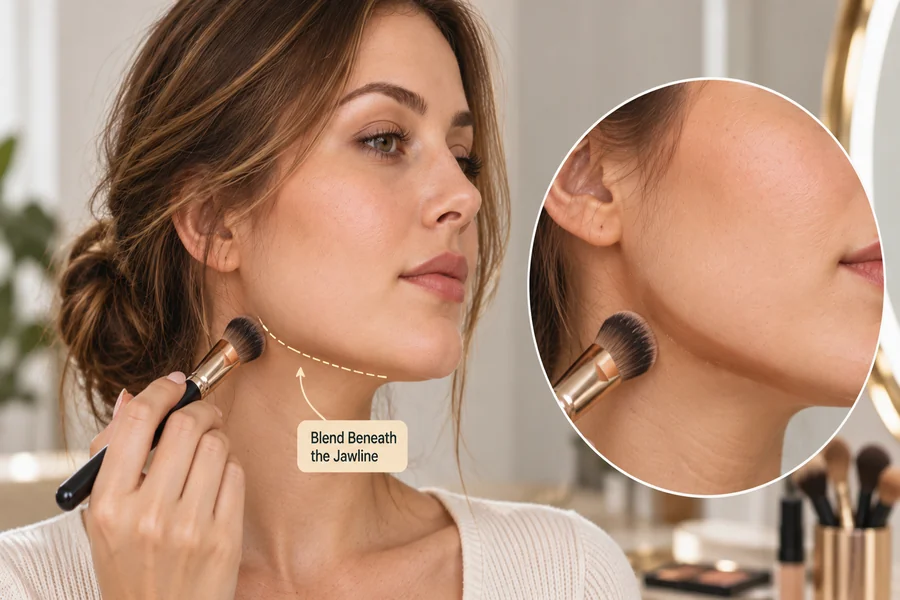
Use Makeup Contouring
Subtle contour beneath the jawbone can create additional visual definition.
Support Skin Health
Sunscreen, moisturizers, and appropriately selected retinoids support skin appearance but cannot reshape facial bones.
Understanding a Soft Jawline With Facefy
If you want to explore how your soft jawline contributes to facial proportions, Facefy’s jawline rating feature provides a relevant starting point.
Examining jawline characteristics alongside face shape and chin proportions can help you make more informed styling decisions.
Use facial analysis results as appearance-related references rather than definitive judgments about attractiveness.
Do Jawline Exercises Actually Work?
Evidence supporting dramatic cosmetic improvements from jawline exercises remains limited.
Chewing and facial movements may activate muscles but do not necessarily create sharper contours.
Excessive chewing can aggravate jaw discomfort or temporomandibular joint problems.
Non-Surgical Treatments for a More Defined Jawline
Professional treatments may address specific concerns involving projection, facial volume, or skin laxity.
Jawline Dermal Fillers
Hyaluronic acid fillers can add volume along the mandibular border.
Results vary, and complications include bruising, swelling, infection, and rare vascular injuries.
Chin Filler and Chin Augmentation
Chin filler may improve projection, while surgical implants offer longer-lasting structural changes.
Treatment suitability depends on individual anatomy.
Masseter Botox
Botulinum toxin can reduce enlarged masseter muscles and lower-face width.
It does not necessarily improve definition and may cause chewing weakness or facial asymmetry.
Other Clinical Treatments for a Soft Jawline
Injectable Fat Reduction
Deoxycholic acid injections may reduce submental fat in eligible adults where approved.
Multiple sessions and careful medical assessment may be necessary.
Radiofrequency and Ultrasound Tightening
Energy-based treatments may modestly improve mild skin laxity, although results vary.
Thread Lifts
Temporary sutures can reposition selected tissues but carry risks of infection, dimpling, and asymmetry.
Neck Liposuction and Neck Lift
Liposuction removes localized fat, while neck lifts address more significant skin and tissue laxity.
Both require surgical evaluation.

Soft Jawline in Women and Men: Is It Attractive?
Soft jawlines can be attractive regardless of gender.
Rounded contours are sometimes associated with gentleness, while angular jaws are traditionally associated with masculine features.
These associations are cultural rather than universal standards.
Overall facial balance and personal preference matter more than jawline sharpness alone.
How to Decide Whether to Enhance Your Jawline
Identify whether your concern involves facial fullness, skin laxity, chin projection, or skeletal structure.
Consider your natural anatomy, desired appearance, maintenance requirements, and tolerance for treatment risks.
Start with reversible styling choices when uncertain.
For medical procedures, consult an appropriately qualified specialist.
Frequently Asked Questions About Soft Jawlines
Can you naturally turn a soft jawline into a sharp one?
You may improve visible definition through styling, posture, or changes in body composition, but natural methods cannot substantially reshape adult jawbones.
Is a soft jawline always caused by excess weight?
No. Genetics, anatomy, aging, and skin elasticity also contribute.
Can facial exercises improve definition?
Evidence for significant cosmetic improvements is limited.
Does a soft jawline mean you have a weak chin?
Not necessarily. Jawline softness and chin projection describe different characteristics.
How long do jawline fillers last?
Results vary by formulation, treatment area, and individual metabolism. Some last around a year or longer.
Is surgery necessary?
No. Styling and nonsurgical options may be sufficient depending on individual preferences.
Final Thoughts
A soft jawline is a normal facial characteristic influenced by genetics, bone structure, fat distribution, and skin quality.
If you prefer additional definition, begin by understanding your facial anatomy and exploring practical styling options.
The goal is not necessarily the sharpest possible jawline, but an appearance that complements your individual features and personal style.