Shops across Canada do most of their blasting in the shoulder seasons, when restoration projects come indoors and equipment arrives for winter refurbishment. That timing matters, because blasting inside a building and blasting in an open yard are two different cost structures, and the difference is what happens to the abrasive after it hits the work.
The Basic Economics
Cheap to Buy, Expensive to Feed
A media blaster costs little against what a shop spends feeding it over a few years. Purchase price is a small share of the total, and abrasive consumption is the line item that decides whether the equipment was a good idea at all. Nobody tracks it, which is exactly why it runs away.
One Pass or Many
A media blaster used in the open consumes abrasive once. The media leaves the nozzle, does its work, and lands on the ground mixed with the coating it just removed, which also turns it into a waste stream that has to be characterized and handled rather than simply swept up at the end of the day.
A containment enclosure with a recovery floor changes that completely. Harder media such as steel grit survives many cycles if it can be collected and screened, and a shop blasting regularly recovers the enclosure cost in abrasive alone.
Screening Makes Recovery Work
Used media carries broken particles and removed coating, and returning that mixture to the pot produces a dusty, slow-cutting stream. A vibrating screen and a dust separator keep the recycled charge usable rather than merely reusable, and without them a recovery floor just circulates the problem.
What the Surface Actually Needs
Profile Is the Deliverable
Blasting gets described as cleaning, which undersells what is happening. Each particle removes a little material and leaves a microscopic crater, and the sum of those craters is a measurable surface profile. Coating adhesion depends on that profile rather than on the absence of rust.
Angular Against Round
Angular media cuts and produces an anchor pattern, while round media peens and leaves a smoother finish. A panel blasted with glass bead looks clean and gives paint very little to key into, and the same panel done with angular grit holds a coating considerably better over its life.
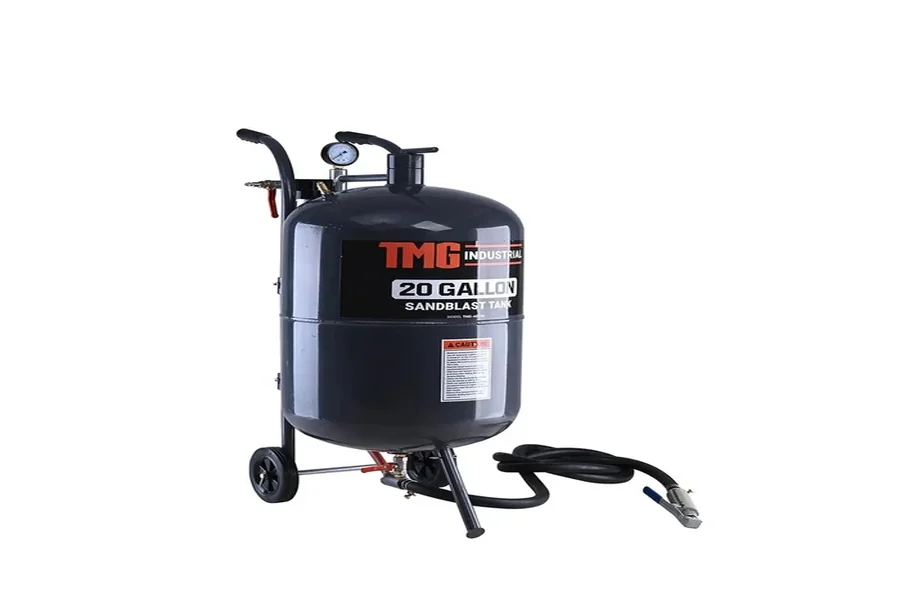
Profile is specified in paint datasheets rather than invented on the job, and most protective coatings name a target range. A 20 gallon pressure sandblaster fed the wrong abrasive produces a surface that is clean, out of specification, and fails from under the paint within a couple of years.
Air, Nozzles and Throughput
Venturi Against Straight Bore
A media blaster with a straight bore nozzle accelerates media to roughly the air velocity. A venturi nozzle expands after the throat and raises particle velocity substantially for the same air supply, which both cuts faster and spreads the pattern wider. Beyond touch-up work it pays for itself quickly.
Air Supply Is the Real Limit
Pressure blasting consumes far more free air continuously than a typical shop compressor delivers. Running on an undersized unit produces short bursts of work separated by long waits, and checking the required volume against the compressor’s actual continuous output avoids that discovery after delivery.
Reading Nozzle Wear
A bore worn larger passes more air at lower velocity, so air consumption rises while cutting slows and the operator concludes the media is poor. Measuring the bore occasionally settles the question in seconds rather than over a wasted season.
Working in a Cloud of Abrasive
Respiratory protection is the non-negotiable part of this work. Abrasive blasting generates fine airborne particulate whatever the media is, and a supplied-air hood rather than a filtering mask is the accepted protection for anyone holding the nozzle. That distinction appears in every regulation on the subject.
A few controls cover the mechanical hazards:
- Bond the blast hose and check couplings under pressure
- Fit a deadman control that stops flow when released
- Keep the dust collector on an enclosure maintained
- Use alternatives to silica sand wherever possible
Silica sand brings crystalline silica exposure, which is why most commercial shops have moved away from it. An operator in a blast cabinet with a tired collector works blind, and operators who cannot see the work compensate by lingering, which is how substrate gets cut.
Where Blasting Is Moving
The direction is containment, recovery and lower-dust abrasives, driven by exposure rules and waste cost rather than cutting performance. Vapor and slurry blasting, which carry the abrasive in water, are moving out of specialist use because they suppress dust at the source.
For a small shop the conclusion is that the abrasive strategy should be settled before the pot is bought, because it determines enclosure, recovery and disposal together. TMG Industrial gives pot capacity, required air volume and nozzle sizes in one listing, which tells a buyer whether an existing compressor can run the unit.