
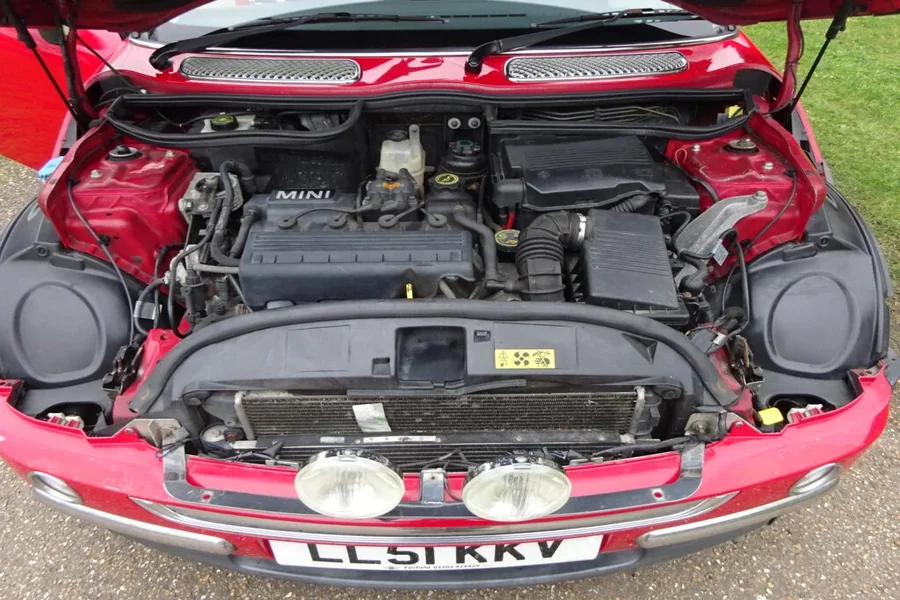
I bought my first used Mini with 74,000 miles on the clock and a folder of receipts that told a story I didn’t want to read. Oil changes every 12,000 miles. Brake fluid never touched. The clutch felt vague and the timing chain rattled on cold starts. That car taught me more in eight months than a decade of driving Japanese hatchbacks, mostly because I ignored the maintenance schedule and paid for it twice. Here’s what I’d do differently, and what I’d hand to a shop without a second thought.
The short version: Mini maintenance succeeds or fails on fluids, fuel, and knowing your own limits. Everything else is small potatoes. Get those three right and a well-kept Mini will stay lively for a very long time. Get them wrong and you’ll fund a repair bill that makes the car’s purchase price feel like a rounding error.
Start With the Fluid Nobody Wants to Talk About
Engine oil is the one item you can’t cheap out on, and the reason is boring but real: the engine in a Mini runs hot and tight, and it depends on a full synthetic film to keep metal off metal. Use a high-quality full synthetic in the weight your owner’s manual calls for. Older first-generation cars like the R50, R52, and R53 with the Chrysler-built Tritec engine have their own preferences, while the turbocharged Prince engines in later cars want a slightly different spec.
If you’re pricing oil changes, look at the federal fuel economy and engine data collected by the U.S. Department of Energy. It won’t tell you which oil to buy, but it does make one thing clear: small displacement engines that are tuned for output live closer to their limits than the big lazy four-cylinders in a Camry. That’s the whole argument for short oil intervals.
My rule: change it every 5,000 to 7,500 miles, or once a year, whichever comes first. The onboard service light is a minimum, not a target. If you only drive short trips around town and the oil never gets fully warm, cut that interval rather than stretch it. Condensation in the crankcase is a real thing, and it’s how you end up with mayonnaise under the oil cap.
Fuel Choice Matters More Than You Think
Turbo Minis want premium. Not sort of premium. The engine and its turbocharger are designed around high-octane fuel, and running regular in a car that specifies it is a slow-motion downgrade. Knock sensors will pull timing to protect the engine, which means you lose the power you paid for and gain nothing at the pump.
My Cooper S was happiest on 93 when I could get it. If 93 isn’t sold in your state, 91 is fine. The price gap between mid-grade and premium is usually a few dollars a tank, and that’s the cheapest horsepower insurance you’ll ever buy. Please don’t put E85 anywhere near it unless the car was built for it, and even then, know what you’re doing.
Fluids Schedule I Actually Follow
Manufacturers love the phrase “lifetime fluid.” Lifetime means the lifetime of the warranty, not the lifetime of the car. Here’s the schedule I’ve settled into after a few hundred thousand combined miles across three Minis and a stack of forum threads I’ve cross-checked against shop invoices.
- Engine oil and filter: every 5,000 to 7,500 miles.
- Transmission fluid: every 30,000 to 40,000 miles, whether it’s an automatic or a manual gearbox.
- Brake fluid: every two years, regardless of mileage. Brake fluid absorbs water from the air and the pedal gets soft before it gets dangerous.
- Coolant: follow the manual, but don’t go past five years on the original fill in a daily driver.
- Cabin and engine air filters: once a year. They’re cheap and you can do both in your driveway.
Notice what’s not on that list: nothing about premium detailing products, nothing about boutique additives. Skip the additives. I’ve never seen one fix a problem that a fresh fluid change wouldn’t have prevented.
Is It Worth Doing Yourself?
Sometimes, yes. Oil changes, filters, wipers, spark plugs, and battery swaps are all reasonable jobs for a patient home mechanic with a floor jack and a torque wrench. Minis are cramped but not hostile. The engine bay is tight, and you’ll skin a knuckle or two reaching the oil filter housing, but nothing there requires a lift or a factory scan tool.
Some jobs are a different story. Timing chain work, clutch replacement, transmission internals, and anything that touches the electronic modules are jobs where the diagnostic software is half the battle. Here’s the split I’d draw for a friend:
- Do it yourself: oil and filter, air filters, wipers, battery, brake pads if you’re comfortable, spark plugs.
- Get a second opinion first: any warning light you can’t identify, odd noises on cold start, rough idle that comes and goes.
- Hand it to a shop: timing chain, clutch, transmission service, cooling system repairs, and every fault code that talks about the ECU, ABS, or airbag system.
On brakes specifically: pad wear sensors live in the front pads on most Minis, and they’ll tell you when the pads are done by lighting the dash. If the light is on, don’t wait. Squeezing another month out of worn pads is how a $250 pad-and-rotor job becomes a $900 caliper replacement. I’ve done that to myself exactly once.
What a Year of Mini Upkeep Really Costs
Let’s use my most expensive year as an example. My 2013 Cooper S hatch did roughly 9,000 miles that year. Two oil services at $120 each. A brake fluid flush at $110. Transmission fluid at $260. One set of front pads and rotors at $520, which stung because I waited a few thousand miles too long. Total: about $1,130, or roughly $94 a month.
Contrast that with the year I let things slide: a failed water pump, a stretched timing chain, and a clutch job that wandered into a flywheel replacement. The bill was north of $4,000. The lesson wasn’t subtle. If you want to know what’s actually required versus what’s a sales pitch, a full guide covering everything you need to know about Mini Cooper maintenance can save you hours of forum scrolling. I wish I’d read one before my first timing chain.
For comparison, the average cost of ownership data tracked by AAA shows routine maintenance is one of the smaller line items in most household budgets. Minis aren’t dramatically different from other European hatchbacks. They’re just less forgiving of skipped service.
Common Sense Steps That Pay Off
Four habits, no tools required:
- Check the oil level at the pump every other fill-up. Minis can consume a little oil between changes, and a low sump is a slow death for the engine.
- Walk around the car once a week. Look at tire pressures, look for fluid spots under the front end, look at the tread. Ten seconds, real payoff.
- Write the date and mileage on every receipt and keep them in the glovebox. When you sell, that folder is worth real money.
- Read your owner’s manual once, cover to cover. Thirty minutes, and it’s the most accurate Mini book you’ll ever own.
Repairs and Recalls Are Not the Same Thing
One more thing that trips up a lot of owners: a repair you pay for and a safety recall are entirely different. If your VIN is covered by an open recall, the manufacturer repairs it for free at an authorized dealer, no matter who services your car otherwise. You can check your VIN in about a minute through the recall lookup maintained by the National Highway Traffic Safety Administration. I’ve been burned by a missed recall notice before, and a two-minute check would have saved me three hundred dollars.
Mini ownership rewards the boring stuff. Fresh fluids, correct fuel, and a willingness to admit when a job is above your pay grade. Do those three and the car stays fun.
So here’s a question to sit with: when was the last time you actually opened your service book and looked at what’s due next?